
May, Falling Green
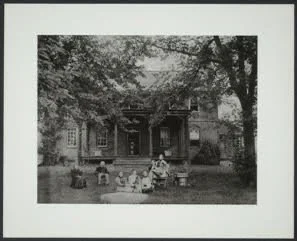
1) “1895 photograph of Charles Brooke and family on the lawn in front of the Falling Green house.”
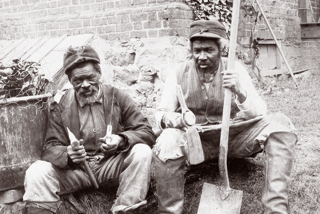
2) “Ca. 1900 photograph of two farmer laborers posing with the tools of their trade in hand at the corner of Falling Green house. They are likely Caleb Robinson and Thomas Walker who worked for Charles Brooke around the turn of the twentieth century.”
Built ca. 1764 for Basil Brooke, Falling Green is representative of the interdependence relied upon by both the Black and White communities of the greater Sandy Spring area. Over successive generations it witnessed the transition from slavery to a wage-labor and tenant-based system of agriculture. The family’s progenitor and Basil Brooke’s father James Brooke accumulated nearly 20,000 acres of land in his lifetime and was by far the richest man in what is now upper Montgomery County. He established numerous plantations such as Falling Green for himself, his children, and his grandchildren. While James Brooke utilized enslaved labor to cultivate the land that he farmed, he relied heavily on a system of tenant farms from which much of the family’s wealth was derived. In the case of the 700-acre Falling Green, in 1783 it included fourteen “log cabbins” and an equal number of “old Tob’c [tobacco] houses” to be tenanted.
Following generations become even more dependent on tenant farmers amid Friends’ growing opposition to slaveholding, manumitting those they held in bondage. Basil Brooke gradually manumitted his enslaved people between 1779 and his death in 1794. And Basil was part of the committee established by the Friends Meeting in 1778 to visit with slaveholding members and convince them to manumit also. Basil’s son Gerard Brooke, who inherited Falling Green, manumitted nearly all his enslaved by 1793. Gerard’s son Richard and his son Charles held no slaves yet continued to remain dependent on the labor of (paid) Black farmhands, domestic servants, and tradespeople. Likewise, their tenants include Black farmers, some formerly enslaved at Falling Green.
Tamar Bond was among them. She and her husband John Bond operated a tenant farm at Falling Green, at times engaging in farm labor for the Brookes as well. John works primarily as a skilled carpenter upon whom the Brookes relied upon to build and repair their tenant houses and outbuildings. Like many Black families of the era, the Bond family’s economic security required full family engagement. Tamar works some years in lieu of rent and they hired out children Basil, Lewis, and Lishi to work at Falling Green as well. Basil Bond was later instrumental in founding the free Black Mt. Zion community when he and Joseph Nugent pool their resources to purchase 56 acres from the Brookes in the 1840s.
Ignatius Ross, commonly referred to as “Nace” or “Nacy” and born in 1796 was the last to be manumitted by Gerard Brooke in 1815, although not freed until 1817 when he reached age 21. During that two year period, Gerard arranges for him to work for William Dorsey for $40 per year. The account book states “of course claim nothing” of Nace’s pay. Quaker testimony prohibited profiting from slave labor, so Nace’s earnings are set aside for him. By 1820 Ross is free to make his own decisions regarding his labor. He is living with his wife Harriet in their modest home in Ashton and working as a farm hand for Caleb Stabler of Drayton Farm near Spencerville. While entailing a daily walk to and from work, a distance of about 3-1/2 miles, he is able to command what one farmer claimed was paid “a good man.”
Caty Owens was a free Black woman making her way on her own as a seamstress, one of the few skilled jobs available to Black women of the period. For at least sixteen years, between 1807 and 1824, Owens made clothing for the Brooke family including waistcoats, breeches, pantaloons, and overalls. Hired on a regularly basis, Gerard Brooke notes in 1811, “Caty has engaged to work for $2 p[er] month which I consider great wages.” While still lower than the average farm laborers rate (even considering the forty percent differential between men’s and women’s work) Caty maintained other clients.
The history of Falling Green reflects the broader transformation of the Sandy Spring community from a plantation economy rooted in slavery to one sustained through wage and tenant labor, skilled trades, and emerging free Black communities. Although the property originated within the wealth and landholdings of the Brooke family, its continued operation depended upon the labor, knowledge, and cooperation of both Black and White residents across generations.
