
Carriage Returns to Sandy Spring Museum
If you thought you were hallucinating when you saw a wooden carriage coming down Route 108 on Thursday, September 10, rest assured that there is nothing wrong with your eyesight!
The carriage, which once belonged to Dr. Jacob Wheeler Bird, had been temporarily stored in a nearby barn but has now returned to Sandy Spring Museum for permanent display. Getting it back to Bentley Road, however, presented an unusual challenge. Long-time museum supporter, Tom Farquhar, conceived an ingenious way to hitch the carriage to a diesel-powered horse (also known as a tractor), allowing it to make the roughly 1.5-mile journey from the barn to the museum and creating a memorable sight along Route 108 in the process.
The carriage was donated to the museum in 1997 by Dement Bonifant and restored in 2006.
Dr. Bird is a well-known figure in local history. He is said to have delivered between 3,000 and 4,000 babies during his career. He is also remembered for making house calls in a horse-drawn carriage before eventually purchasing an automobile and, according to local lore, he wore out 35 in his decades of medical service.
When Sandy Spring Museum announced that the carriage would be moving back to the museum, Keitha M. Lindsey reached out to introduce herself. “I am the great-granddaughter of Llewellyn Bishop, who was Dr. Bird's driver for many years,” her email began.
Museum Director Allison Weiss called her immediately. “We were so excited that a descendant contacted us. We invited her to take a ride in the carriage.”
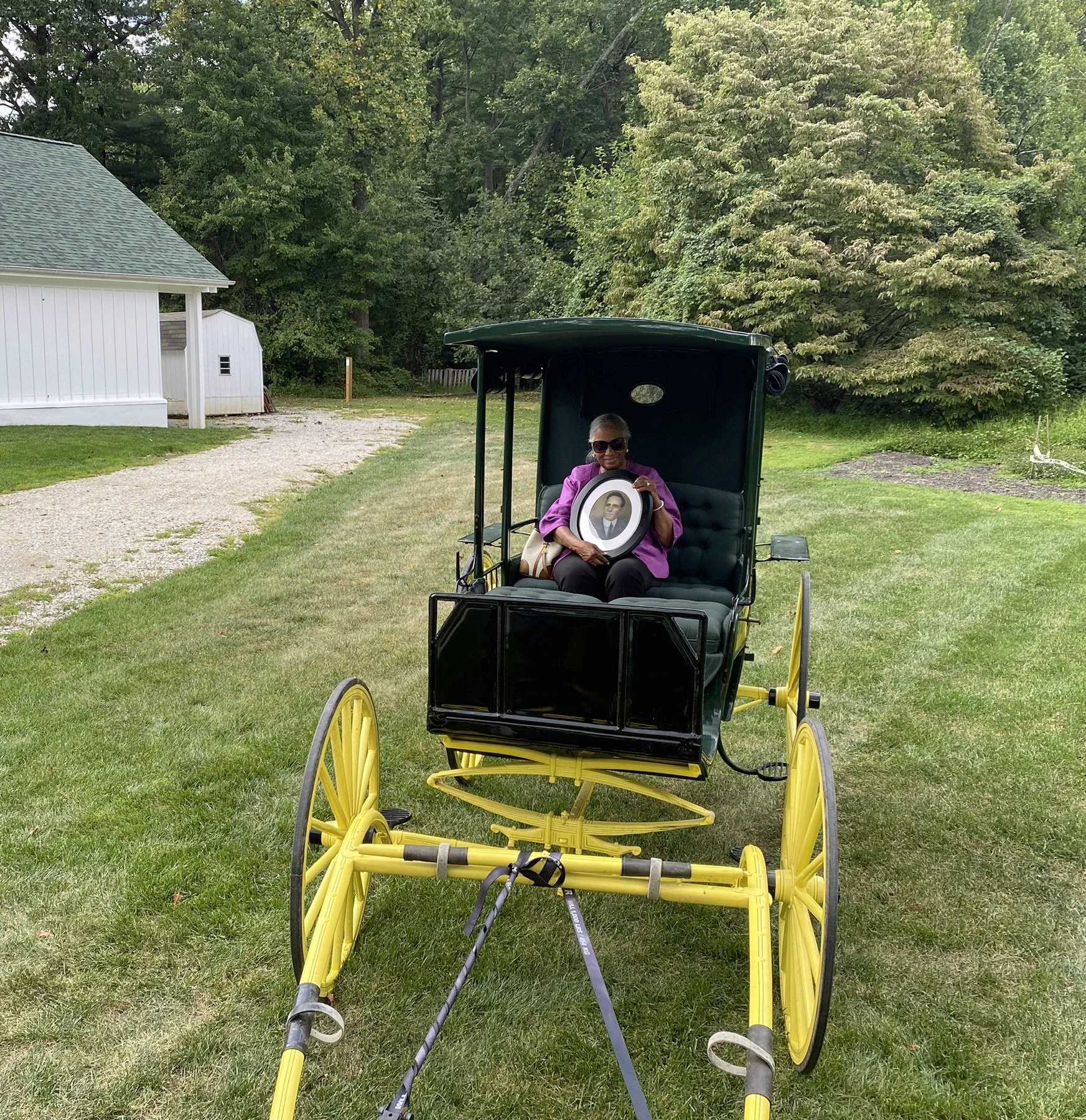
Born in 1879, Llewellyn Bishop appears to have had a close relationship with his employer. According to Ms. Lindsey, racial barriers made it difficult to purchase land in his own name. Dr. Bird purchased land on Norwood Road, and Mr. Bishop paid him back. Bob Hill constructed the house where Llewellyn lived with his wife and children.
Ms. Lindsey remembers that the property had a hand-built brick grill and an outhouse, which she was afraid to use.
“This was the only job he had. He must have done all right because he put his two kids through college,” commented Ms. Lindsey, who teared up upon seeing the carriage. “I was only 7 when my great-grandfather died, but I remember that carriage.”
Llewellyn’s father, Archibald Bishop, escaped enslavement from the Bishop Plantation in North Carolina. Ms. Lindsey says he settled in Sandy Spring because of its free Black population. She recalls that her great-great-grandfather had a house behind where the Olney Theatre now stands.
Mr. Bishop, who was also a deacon at Sharp Street United Methodist Church, died on January 4, 1950 and was buried in Mutual Memorial Cemetery.
