
April, Walnut Hill
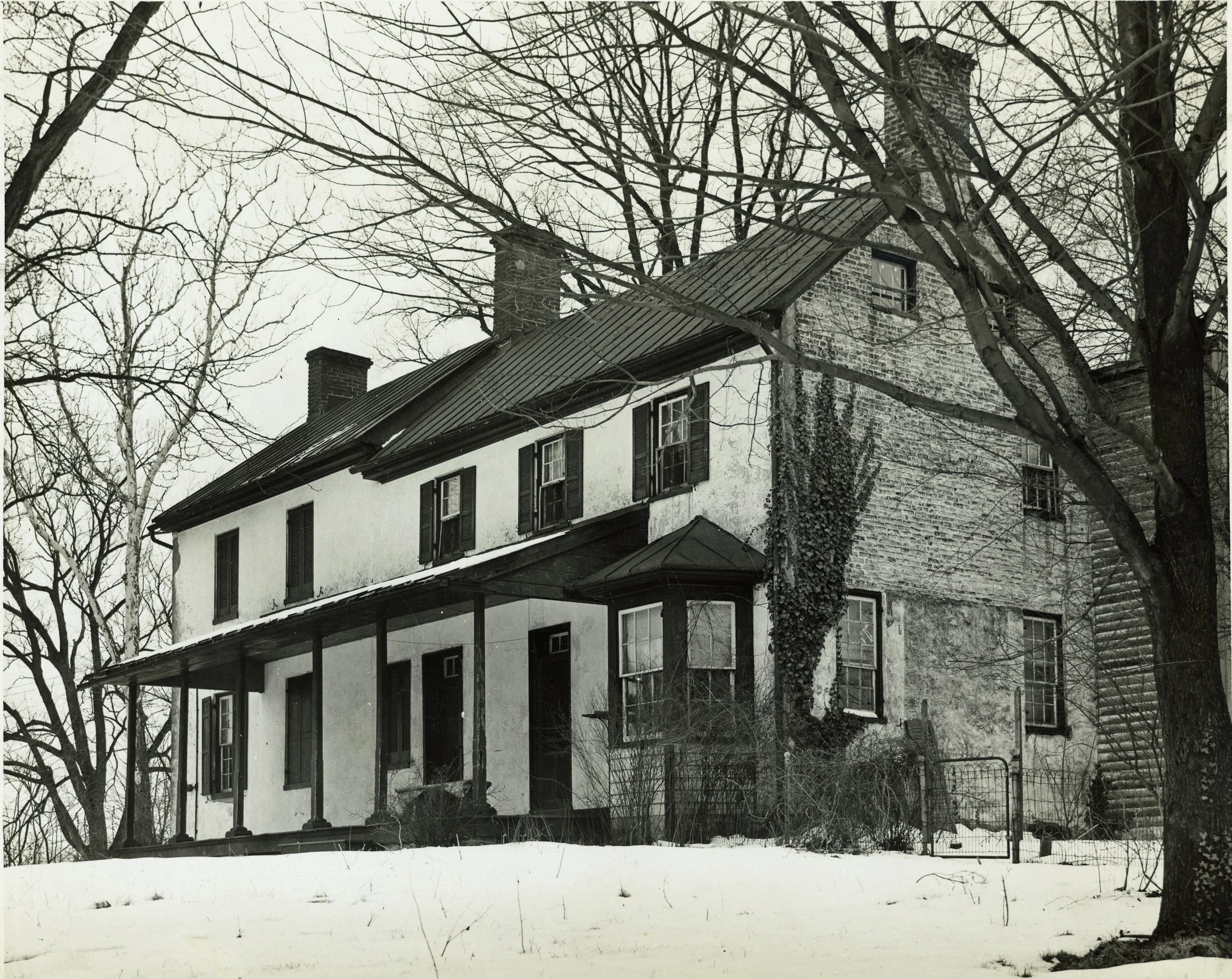
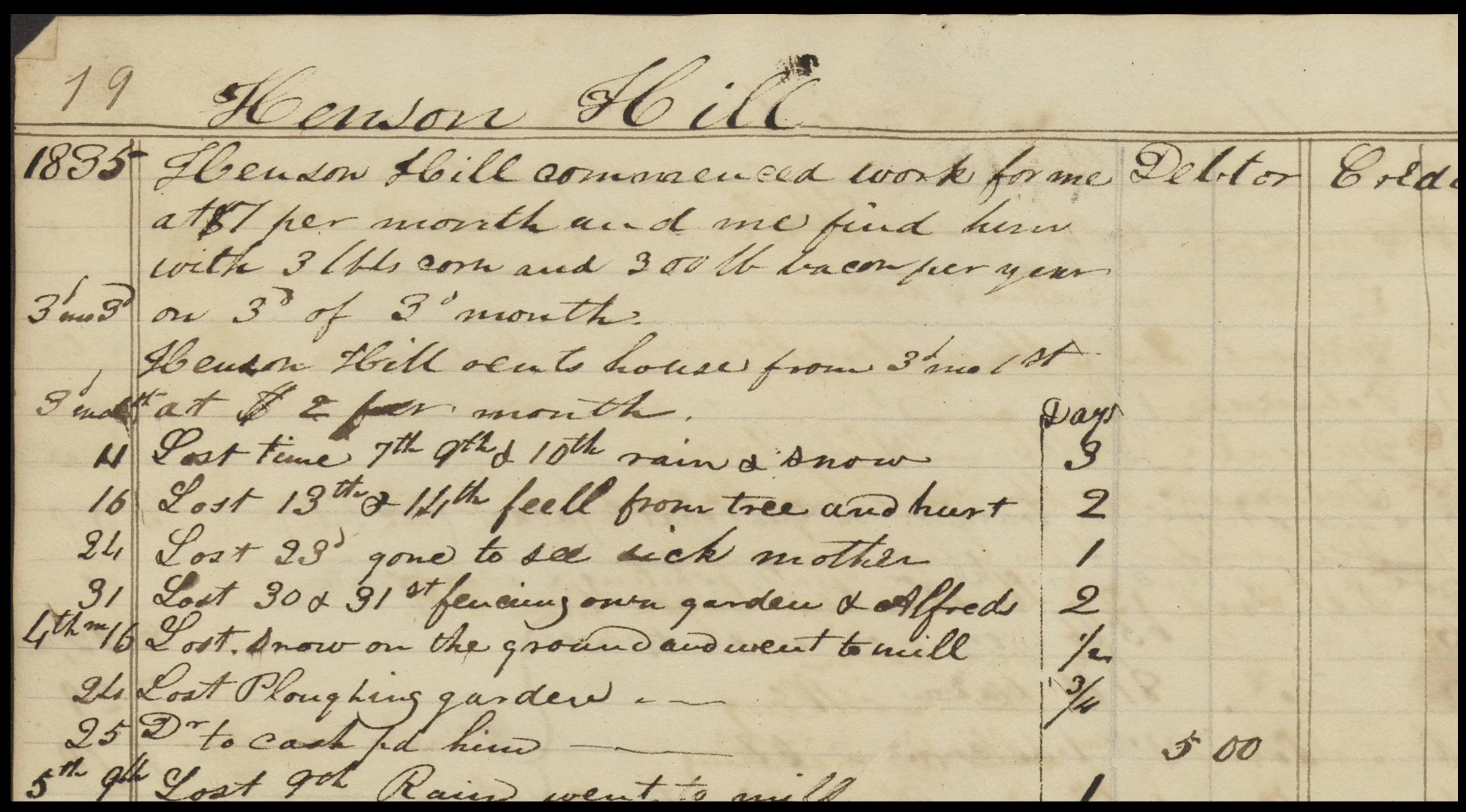
Pictured is Walnut Hill (top) and an excerpt from a Lea Family ledger (bottom). This page is from the farm ledger kept by son George Lea in the 1830s of the account for free Black farm hand Henson Hill. The entries indicate the terms of his employment and that he is renting a tenant house. The notation “Lost” means lost time for which he will not be paid. Hill loses time to "ploughing garden” indicating his own kitchen garden and to “see sick mother” Margary Hill who was formerly enslaved by the Thomas family.
Free Black laborers and families played a central role in shaping Walnut Hill, where they lived and worked alongside the Lea family for more than four decades. Like Hannah Peirce of Black Meadows (Riverton), her cousin Elizabeth Lea inherited Walnut Hill as the granddaughter of James Brooke. Encouraged by Hannah, Elizabeth and her Husband Thomas Lea leave the Brandywine to arrive at Walnut Hill in 1823. They too inhabited a pre-existing log house, formerly occupied by tenant farmer David Frame. By the end of the year, Thomas Lea could report, “We have got through with our improvement about the house & shall now be verry [sic.] comfortable, our house is small but with the porch, back shed & a large work shopp [sic.] that we have put up, we shall have room for our family & friends & hope they will come to see us.” Lea wasted no time in acquiring dependable farm labor within the free Black community, likewise reporting “I have 4 good Black men.” Over the course of their approximately forty-four-year tenure at Walnut Hill the Leas employed at least twelve free Black persons including a number of Black children who resided in their house.
Henson Hill is among the longest serving free Black farm laborers who worked for the Lea family. Henson and his wife Anna and their young family likewise lived at Walnut Hill, from 1835 to as late as 1853, when Henson purchased land in the Cincinnati and build his own house. No longer defined by tenancy and contractual labor, Hill is considered to be one of the community’s founders. Like Remus Hill, Henson was a son of former enslaved Hazel and Margary Hill. Hill received wages as well as a monthly allotment of bacon and corn, likely living in the old log house (the Leas having now built the first section of their brick house). Hill maintained his own garden where he grew food for his family and had space to raise chickens and keep a few pigs, reflecting the subsistence farming and self-reliance that sustained Black households. In addition to his agricultural skills, Hill helped construct the stables at Walnut Hill in 1836. His son Remus Hill later returned to Walnut Hill in the 1870s agreeing to work for then owner Edward Gilpin, reflecting both the limited employment opportunities and the enduring ties that existed between the Black and White farm families.
Pricilla Boothe worked as a cook and domestic servant, among the few avenues through which Black women of her era could earn an income. She was 64-years old when working in the Lea household in 1850. Although unrecognized, it is likely that she helped Elizabeth Lea develop the additional recipes and tips that appear in the 1851 revision of her well-known cookbook and aid to young housewives, Domestic Cookery and Household Hints. Boothe may have also been present for the first edition published in 1845.
At only eleven years of age, Margaret Sugars was one of three young free Black people living at Walnut Hill at the time of the 1850 census. None of them are list with an occupation, suggesting that Elizabeth Lea took them in as orphans or from families in need of assistance. In the “Domestics” section of Domestic Cookery Lea speaks favorably of such arrangements. Sugars likely worked in exchange for care and possibly some additional income for her family. In 1856, at age 16, Sugars obtained a Certificate of Freedom describing her as “five feet one quarter inch high of mulattto complexion has a mark on the right side of the face from the scratch of a pin was born free.” By 1860, two years after Elizabeth Lea’s death, Margaret Sugars secured a new position with the Farquhar family at The Cedars in Sandy Spring, continuing her life as a domestic servant.
