
Entry 6, June: Bloomfield
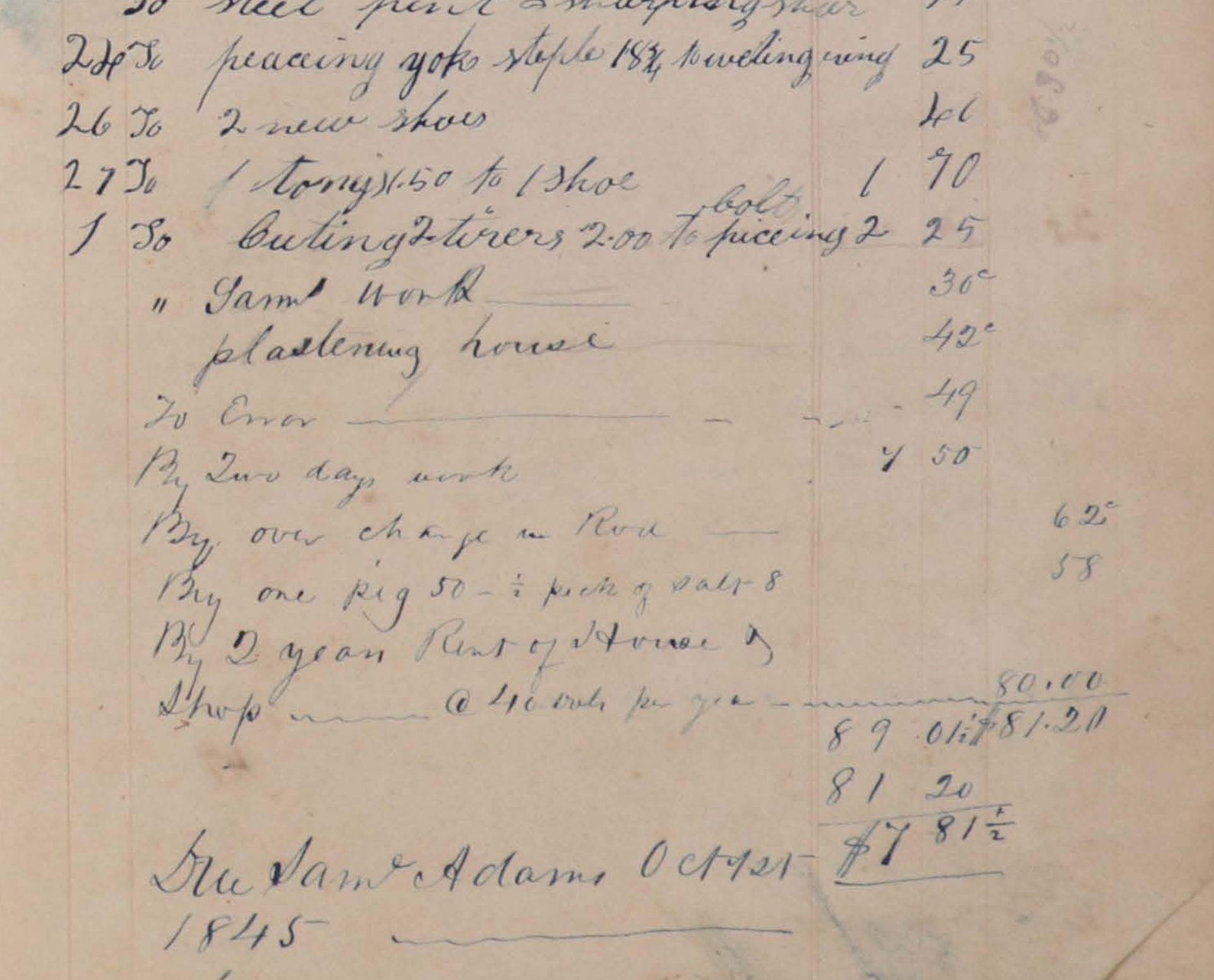
1) Samuel Adams’ business ledger shows both his rental of the Bentley-owned blacksmith shop and what appears to be work on the ca. 1845 addition, including a yoke “for dwelling wing” and “Sam’l work plastering house” for Richard T. Bentley.
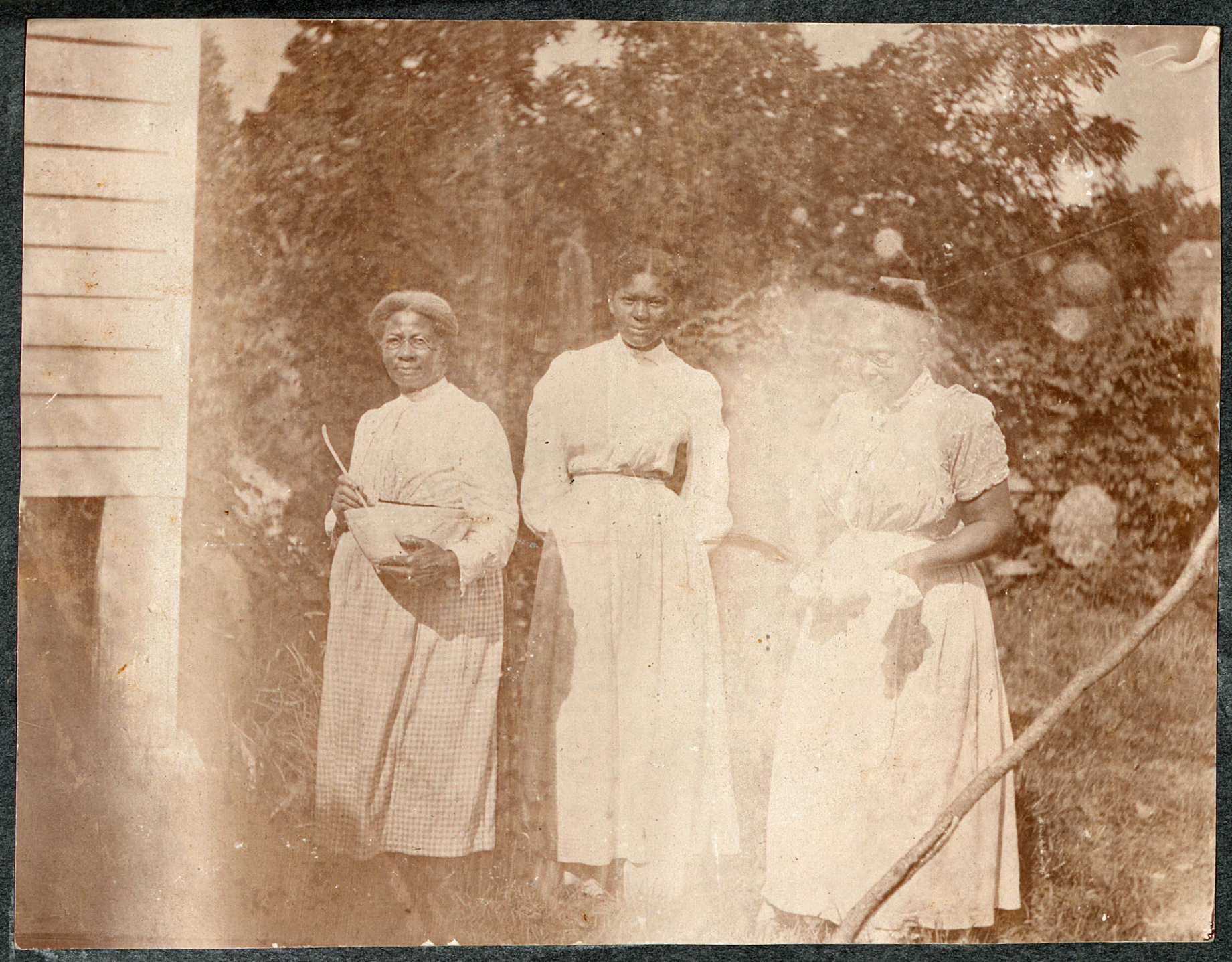
2) The ca. 1900 photograph taken in front of Bloomfield features Black female domestics. Signaling her position as cook by holding a mixing bowl is Agnes Alcorn.
Bloomfield was more than just the home of Caleb Bentley and his son Richard T. Bentley, it was a center of opportunity that helped free Black individuals and families in Sandy Spring build businesses, acquire land, and establish lasting roots in the community. The Bentleys provided employment opportunities and housing to dozens of local free Black individuals and families, while working with free Black trades people who established businesses such as blacksmithing, shoemaking, livery services, and huckstering. They did so by renting commercial properties and helping procure tools and materials through their general store. The Bentleys also took on loans and “small debts” to provide Black families credit to meet short-term needs, provided pensions and “lifetime houses” to elderly Black individuals, and sold land that enabled free Black people to establish home sites and subsistence farms. Although documentation is limited, Richard Bentley—whose father-in-law John Needles was first president of the Friends' Association in Aid of Freedmen—may have assisted in the operations of the Underground Railroad in Sandy Spring.
Over several decades, Bentley’s blacksmith shop provided economic opportunity for free Black families, connecting successive generations of tradesmen whose work helped strengthen the community’s economic foundation. Samuel Adams rented the blacksmith shop in the 1840s. Adams was originally from Catonsville where he and his brother Remus operated a successful blacksmith shop that they inherited from their father, John Adams. Samuel relocated to Sandy Spring in his pursuit of Martha Ellen Hill, whom he married on November 21, 1843, in a ceremony overseen by a Quaker minister. Martha was the daughter of Hazel and Margary Hill, a formerly enslaved free Black couple. Martha’s brother John Wesley Hill was a renowned conductor on the Underground Railroad and later a resident of Oakville, Canada, known as “Canada Jim.” Samuel and Martha were also active in the network and eventually settled in Canada themselves. Not only was Adams literate and skilled in a lucrative trade, but he was also able to negotiate between free and enslaved Black individuals as well as Whites to convey pre-emancipation ideals of Black freedom and success. Evidence suggests that the Adamses’ Sandy Spring Quaker connections helped sustain their involvement in the freedom network. The likelihood that Adams actually befriended the Bentleys is suggested in an 1894 letter from his brother Remus, still in Maryland, where he states, “Mr. and Mrs. Bentley send their love to you.”
Between 1857 and 1885, two generations of the Budd family—Perry Budd and his sons Samuel and Thomas—rented the blacksmith shop from the Bentleys who were also among their customers. The Budds worked together to provide a good living for their extended family and in the process, build generational wealth through land ownership. In 1855, Perry Budd purchased 10 acres from Richard Bentley at a cost of $150, and an additional 22 acres from Thomas Brooke in 1856, making him one of the largest Black landowners in Sandy Spring. Budd’s real estate in 1860 was valued at $1,100 at a time when the median value of Black-owned real estate in Maryland was $300 to $400. The Budds likewise mentored other young free Black men in the blacksmithing trade including E. Fletcher Clark, who later applied those skills to shoeing horses at the livery stable that he too rented from the Bentleys before acquiring his own.
Like many free Blacks of Sandy Spring, Fletcher Clark illustrates the pursuit of multiple occupations to achieve financial stability and success. Between 1880 and 1886, Clark rented a house and adjoining stable from Richard Bentley where he operated a livery and blacksmith shop. He provided services relating to horse and wagon transportation, including shoeing horses, repairing wagons, and providing driving and huckstering services. Clark also served for nearly twenty years as the sexton for the Friends meeting house property. In 1888 Clark purchased land on Norwood Road from Arthur Stabler of Harewood where his brother-in-law Lewis Hill built him a house and a shop building of his own. Fletcher Clark too became one of the wealthiest members of the Black community. As daughter Addie commented, “We really lived very good.”
While Black male artisans and entrepreneurs built businesses on the around Bloomfield, Black women contributed through forms of labor that were no less essential. Among them was Louisa Cook, the wife of Reverend Warner Cook, who supplement the family income by washing the Bentley family’s laundry. Agnes Alcorn served as Bloomfield’s live-in cook around the turn of the century. She was the daughter of Edward Alcorn who operated his own farm in the Cincinnati kinship community. Both exemplify the often unrecognized work of Black women who balanced their own household responsibilities with the need to support for their families. For most Black women, domestic service was one of the few professions open to them and that offered a degree of flexibility that made that careful balance possible.
