
Entry 7, July: Auburn
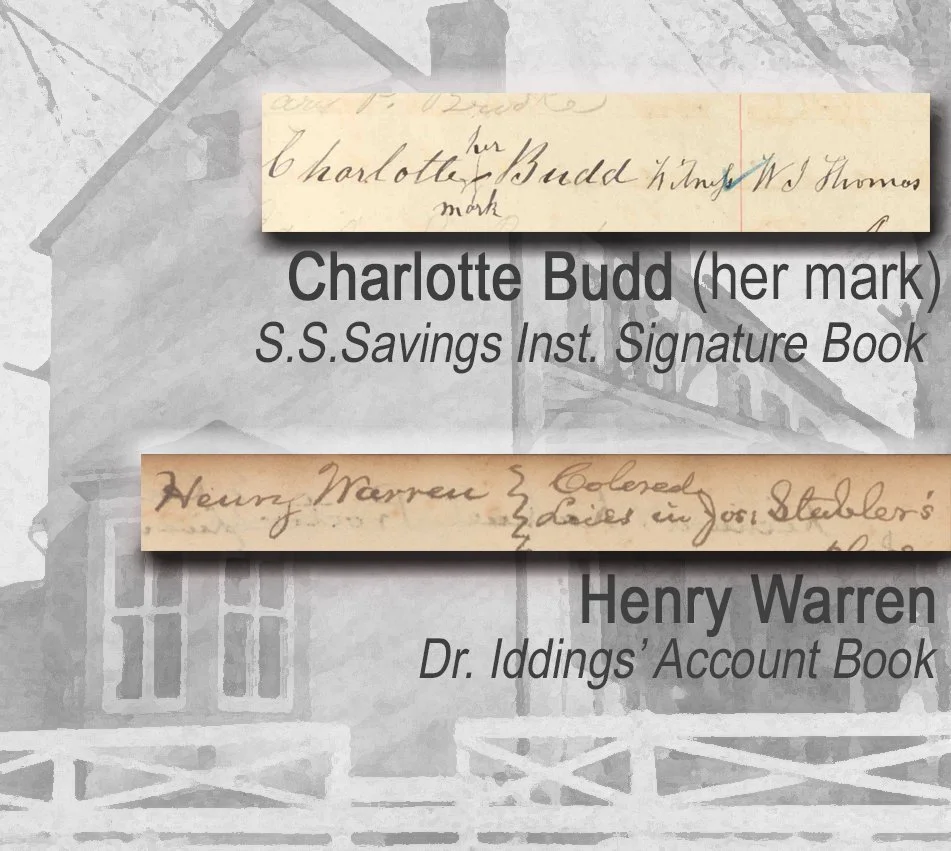
Although there are no surviving farm ledgers for Auburn—the house and farm established by William and Eliza Thomas Stabler ca. 1825—their daughter Ellen kept diaries that provide insight into the lives of the Black men and women who kept Auburn functioning. In particular, are recorded the working lives of the numerous Black women who were essential to the domestic management of Auburn during the mid- to late-nineteenth century. Black men contributed their skills to farming. However, because they operated outside Ellen’s sphere of influence, they generally appear merely as “men working.” Ellen records the “men” plowing fields; planting, harvesting, cutting, and threshing wheat, oats, and timothy; stacking hay, sawing and haul logs, cutting ice to fill the ice house, and more, in effect performing all the fundamental tasks of everyday farm life.
One of the women appearing most frequently in Ellen’s diaries is Rachel Bellows. Bellows spent more than two decades at Auburn undertaking a wide range of tasks from cleaning and cooking, to butchering and sausage-making, and even white-washing interior rooms. Yet Bellows was also a nurse and midwife. As Helen Bentley recalled, “Aunt Rachel Bellows,” was “the nurse for most of us in child birth,” reflecting both the trust placed in her and the value of her work to the women of the community. Born enslaved in Anne Arundel County, Bellows gained her freedom at age twenty-five and migrated to Sandy Spring. She was a highly capable woman who drew on her various skills to successfully build a life as a free individual while gaining the respect of both the Black and White communities.
Lizzie and Charlotte Budd worked at different times as live-in domestic servants at Auburn. Lizzie was 18 years of age when she came to work at Auburn in 1869. The daughter of farm laborer George Budd and his wife Mary, Lizzie, like her sister Eliza before her, began her adult life in domestic service. In 1877, Lizzie was succeeded by the widowed Charlotte Budd. Her position as a live-in employee entailed her daughter Eliza living with another family, reflecting the personal sacrifices made by many Black women in service.
Caroline Sedgwick appears as a laundress at Auburn in 1853, occasional engaging in other activities as needed, such as candle making and meat processing. Sedgwick worked until 1867, when she and her husband Horace Sedgwick had accumulated the resources to purchase enough land to farm independently. Their purchase enabled Caroline to give up her work as a laundress and focus her efforts on her own household.
Becky Bidwell worked occasional at Auburn from about 1874 to 1882, cleaning and doing laundry while maintaining her own household. Becky lived next door in a tenant house at Harewood Farm where her husband Eli Bidwell was a brickmaker. Eli was paid at a rate of $5 for every 1,000 bricks that he produced, some of which were likely used to build the additions at Auburn. Like many Black women in the community, Becky balanced her own responsibilities to home and family with paid labor.
Among the relatively few Black men mentioned in Ellen’s diaries by name is Sam Brown, who assisted in the operation of the lime kiln used at Auburn to produce fertilizer. Washington Johnson white-washed at Auburn and aided in the construction of the original bay window in 1867 and possibly that entire addition. Hamilton Budd likewise performed a variety of small construction and maintenance jobs. Peter Nelson represents one of the many free Black individuals who migrated to Sandy Spring in the aftermath of the Civil War in search of better opportunities. He worked at Auburn in the 1870s while also living in one of the Stabler’s tenant houses. Sandie Scrivener had likewise migrated here by 1870, coming from the tobacco-growing region of Anne Arundel County. Scrivener lived initially with the Stabler family and then boarded with a Black family living in the Cincinnati kinship community. By 1900, Scrivener had migrated to Baltimore, leaving agricultural labor for the city’s more lucrative employment opportunities, as did many Black individuals by this period.
