
Entry 8, August, Rockland
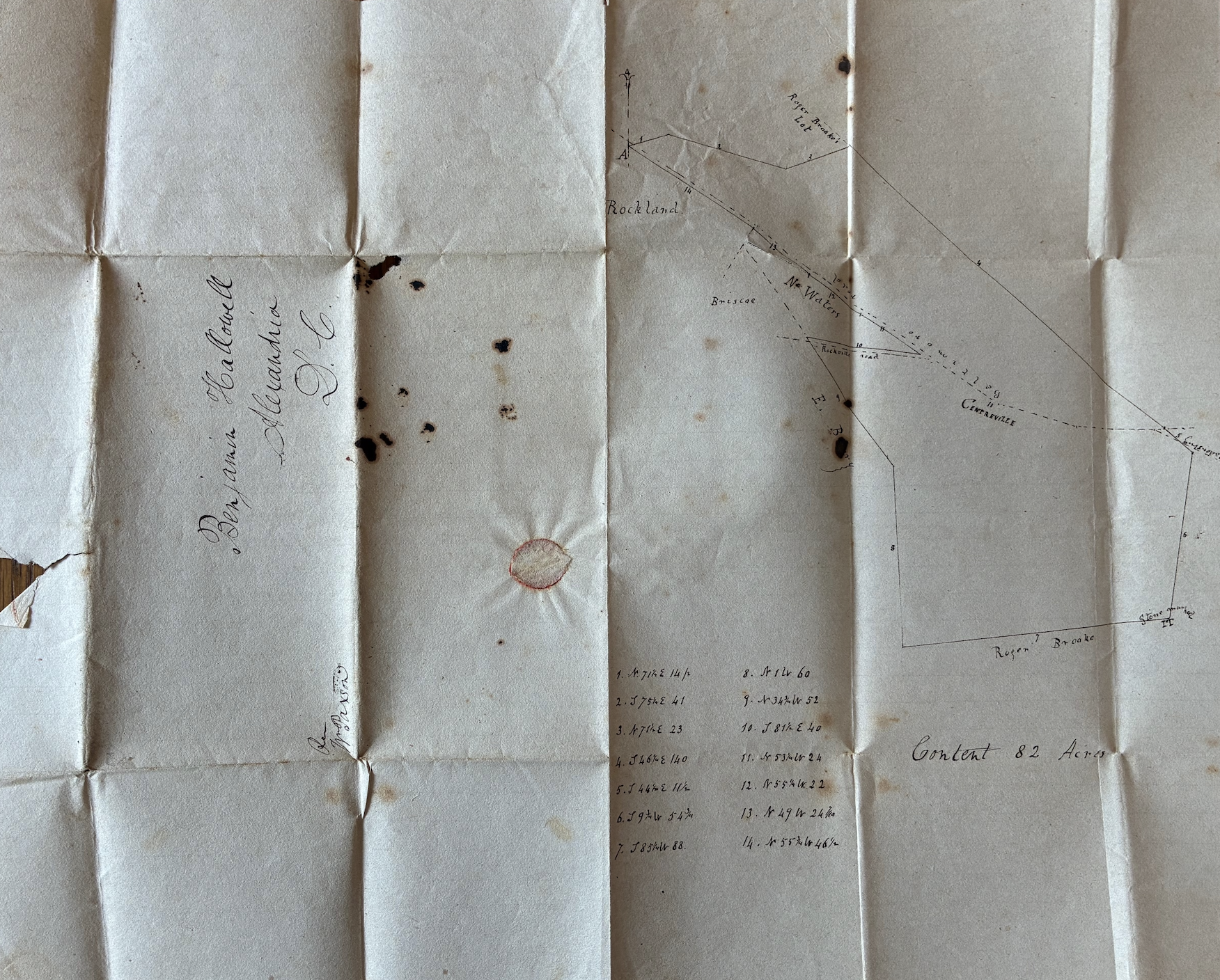
A ca. 1838 plat located within the Sandy Spring Museum archives shows the relationship between Rockland and the adjacent five-acre parcels held by the free Black Briscoe-Elcorn and Waters families.
Catherine Lavoie
Architectural Historian
Built in 1838, Rockland was the home of Benjamin Hallowell, a Sandy Spring Quaker notable for his public commitment to abolition and his sustained relationships with members of the local free Black community. Benjamin Hallowell, his son Henry, and his grandson Francis employed at least a dozen local free Black individuals whose labor was essential to the operations of both Rockland farm and the Rockland School, which operated from 1878 to 1892. They provided housing to some of their free Black laborers in three tenant houses and, in some cases, within their own home. Hallowell also worked to protect the rights of enslaved people through his role as a founder and treasurer of the Benevolent Society for Ameliorating and Improving the Condition of the People of Color, established in 1827 in Alexandria, Virginia. Likewise, evidence suggests that he was involved in the Underground Railroad. Demonstrating his concern for the welfare of free Black families locally, Hallowell helped secure the property rights of one that had long established a homestead on land adjoining Rockland but lacked legal title.
The Briscoe-Elcorn family lived on one of two adjacent five-acre parcels before the Hallowells built Rockland. Joseph Briscoe, a formerly enslaved man who purchased freedom for himself and his wife from their enslaver, John Thomas of Clifton, likely acquired the parcel in 1827. A Bill of Sale executed in October of that year that included furnishings, livestock, and farming equipment indicates that he had established his household and was engaged in farming. Briscoe’s deed, however, was never recorded. During this period, free Black individuals sometimes received land through informal agreements rather than legally recorded deeds, and such property could be passed down through generations in the same manner. Honoring the family’s claim to the land, in 1849 Benjamin Hallowell executed a deed of exchange between himself and Briscoe’s daughter Lottie and her son Edward Elcorn, Joseph by then deceased. Hallowell did the same for the neighboring Black family, headed by Nicholas Waters.
Edward Elcorn cultivated his own land, engaging in subsistence farming, while also working as a farm laborer for the Hallowells. In 1867, he sold land to the Hallowells, purchasing thirteen acres in the Cincinnati free Black community. Elcorn later sold almost half of that property to three other free Black individuals, extending the benefits of landownership to others. Shaped by labor, land access, and mutual support, these relationships and opportunities represent one of the most important legacies of the free Black community.
John Cole was the Hallowells’ longest-employed farm hand and was highly regarded by the family. Cole worked at Rockland for forty years, from 1880 until his death in 1920. He was the son of Campsidie Cole, who worked as a laundress to support her five children. By age fifteen, John Cole was already working as a resident farm laborer for William Schofield. At the same time, he attended school, became fully literate, and later ensured the education of his own children. Cole was nineteen when he took a position as a farm laborer and servant for the Hallowell family while living at Rockland. He later married Perrie Budd, daughter of successful Sandy Spring blacksmith Perry Budd and his wife Eliza. John and Perrie Cole lived in the tenant house “at the back gate” of Rockland, where they raised a large family.
Over the years, a number of Black women and girls also worked at Rockland. Among them was Alvira Hill, who was the family cook for many years, working outside her own home to underpin her family’s financial stability. Teenage girls Emeline and Juliana Budd also worked as resident domestic workers in the 1870s. Later, Mary Clark, the younger daughter of Fletcher Clark, a successful blacksmith and livery stable owner, worked at Rockland. All three young women likely remained in service until they married and then may have worked outside the home occasionally to supplement the family’s income as part of a larger pattern for Black women of their era.
By 1920, no resident domestic workers or farm laborers were recorded at Rockland, although it is likely that others continued to work the property while living elsewhere.
